
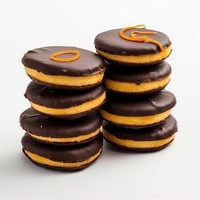
McVitie & Price Biscuit Company
Why does it matter whether British Jaffa Cakes are a cake or a biscuit? These curious cakes are circular, 2 1/8 inches in diameter, and have three layers: a Genoise sponge base, a layer of orange-flavoured jam, and a coating of chocolate. Their Edinburgh manufacturer, McVitie & Price, has been making Jaffa Cakes in Britain since 1927.
For years, these delicacies were considered a cake. As a staple, they were free of the UK’s Value Added Tax of 20%. Then one fine day, Her Majesty’s Customs and Excise decided to question McVitie’s labeling of these delicacies as “cakes” and considered them biscuits instead. The distinction is important. Cakes are not subject to the VAT, biscuits are. The case went to Britain’s VAT Tribunal.
Judge Potter of the VAT Tribunal decided in favor of McVitie’s and their Jaffa Cakes after McVitie’s Queen's Counsel had a giant Jaffa Cake baked and brought into Court to prove that these were cakes and not biscuits. Judge Potter considered several factors, such as texture, ingredients, and the fact that Jaffa Cakes are covered in chocolate. But the factor that tilted him in Jaffa’s favor was that Jaffa Cakes remained spongy after being set out for a time. Cakes remain spongy after they get stale, while biscuits become crusty and hard. Clearly, Jaffa Cakes are indeed cakes. They remained spongy and VAT-free.
It was a long and costly consumption of legal time and talent, but McVities finally tasted sweet success. Britain could have avoided this trouble if it had had the FAIRtax. The FAIRtax taxes all new tangible goods at the same rate without fear or favor. It avoids the problem with taxing food and other basic necessities through the Family Consumption Allowance, commonly known as the Prebate. This feature of the FAIRtax lets everyone buy their basic necessities tax free.
Now the £1.19billion Jaffa Cakes made every year are free of the consumer tax. This means those with a sweet tooth can more easily afford to have their Jaffa Cake and eat it, too.
We thank our friend and London Solicitor Arthur Byng Nelson for making us aware of this case. If you or someone you know ever has a British legal matter, please know that Arthur practices at the London Law Firm of Sherrards Solicitors LLP, and can be reached at arthur.byngnelson@sherrards.com.

Arthur Byng Nelson, Solicitor
In our recent travels, we discovered another characteristic of the UK’s VAT. It does not appear to be as thoroughly disclosed on receipts as in other countries. Here is an example:
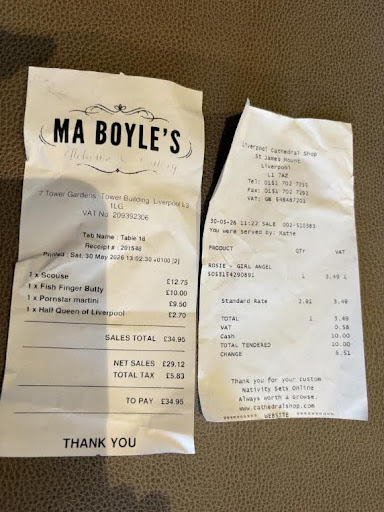
The sales slip on the left is from a restaurant in Liverpool, where we ate scouse. It shows the tax without the rate, which is 20% tax-exclusive, that is, 20% calculated on the net value of the good or service being sold. The sales slip on the right is from the Liverpool Cathedral gift shop, and it also shows a 20% tax-exclusive VAT. This slip omits the net sales price.
The predominant VAT rate in the U.K. is a 20% standard rate, which applies to most goods and services sold in the U.K. There is a reduced 5% rate as defined by His Majesty’s Revenue and Customs for specific categories. Examples are domestic energy, children’s car seats, mobility aids for the elderly, nicotine patches, and some energy-saving materials.
There is a third zero rate, examples of which are most food and drink such as Jaffa Cakes (except alcohol, confectionery, crisps, and ice cream), children’s clothing, books and newspapers, most prescription medicines, and public transport. Technically, these are not exempt goods, although their rate is zero.
A last group of goods and services is truly exempt. Examples are financial services, insurance, education, health and medical services, postal services, betting, and gaming.
So, there we have it. If you have a Jaffa Cakes story, I would love to hear from you.
---------------------------------------------------------
TAKE BACK CONTROL!