
THE DEBT
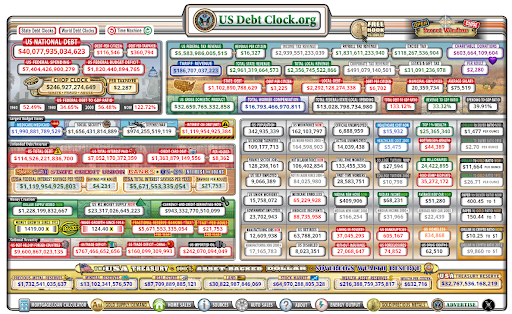
Image credit: U.S. Debt Clock.Org
Recently, the U.S. National Debt crossed the $40 trillion line; that’s right, 40 with a “T.” On top of nominal debt, Congress has made promises it cannot keep or take back, such as overly generous Social Security and Medicare benefits. Most people understand why too much personal debt is a problem. But most people see a $40 trillion national debt as an abstract statistic. Making those numbers real can be a challenge.
Let’s try this. Your share of the national debt comes out to nearly $120,000 or nearly half a million dollars for a family of four. If the national debt were your personal unsecured loan, your yearly effective interest would be over $54,000, or over $4,500 per month. If your share of the national debt were a secured loan or a mortgage, your effective interest would be over $28,000, or over $2,000 per month. And that’s all on top of any other debt you may be carrying.
Zooming out to the big picture, interest payments on the national debt alone now consume over a trillion dollars a year. That’s money that can’t go to infrastructure, defense readiness, medical research, or education. High debt acts like deadweight on the economy. Businesses invest less. Innovation slows. Job creation weakens. The country becomes more cautious, less dynamic.
The government becomes like a family that spends so much on credit card interest that it can’t fix the roof or replace the car. Every new priority becomes a fight. Every emergency becomes more expensive.
As government borrowing crowds out available funds for lending, lenders demand higher real interest rates. That ripples through the entire economy. Mortgages become more expensive. Car loans cost more. Real credit card interest climbs, and small businesses struggle to borrow.
Programs that millions, especially retirees, rely on face growing strain. With so much money diverted to interest payments, Congress has fewer options to stabilize Social Security and Medicare. Americans who worked their whole lives begin to worry. Will my benefits shrink? Will the retirement age rise again? Will Medicare cover what it used to? The debt becomes not just a national issue, but a personal one.
Perhaps the most subtle impact is the feeling that the future is narrowing. Americans sense that the country is living on borrowed time and borrowed money. The national debt becomes a symbol of political dysfunction, short-term thinking, and promises made without plans to keep them.
So, what does this pessimistic outlook have to do with the FAIRtax? Our debt could benefit from the FAIRtax in two distinct ways. First, Section 509 of the FAIRtax bill requires the tax to be separately stated and charged on every receipt for a retail purchase. This receipt must show the price exclusive of the tax, the tax, the price inclusive of the tax, and the tax rate, as well as the date of sale, the vendor's name, and the vendor's registration number.
This information makes the federal government's cost (exclusive of debt) glaringly visible. When taxpayers are constantly reminded of just how much the federal government is costing them, there’s a good chance that they will demand an end to our government’s seemingly unrestrained spending policies and insist that wasteful spending be eliminated.
Second, the FAIRtax base, i.e., consumption, is more stable than the tax base for income and payroll taxes. People tend to smooth out consumption through good times and bad. In other words, people between jobs tend to draw from savings to support the lifestyles they knew when they worked. When they get a new job, they tend to put some of their income back into savings. Thus, their consumption varies less than their income between periods of employment and unemployment. On a national level, people still tend to consume goods and services in times of high unemployment and consume only slightly more in times of high employment.
Because the FAIRtax is based on consumption, consumption tax receipts tend to be lower than income and payroll tax receipts during economic expansion and higher during recessions. Reducing receipts in good times helps politicians spend less.
The FAIRtax may not be the cure-all, but it is certainly a start in the right direction towards addressing our runaway national debt.
If you see other ways the FAIRtax can help with our national debt, I would love to hear from you.
---------------------------------------------------------
TAKE BACK CONTROL!